Nanopillar metasurface-based mechanically compliant mirror

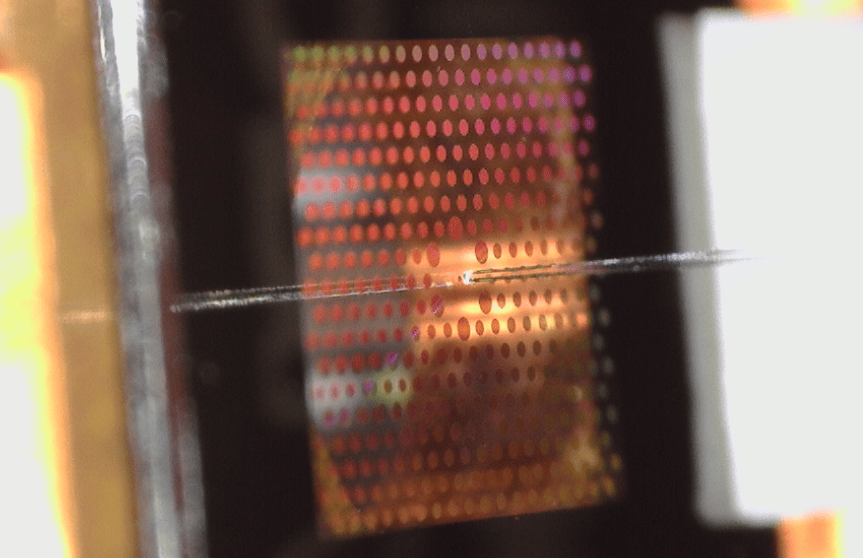
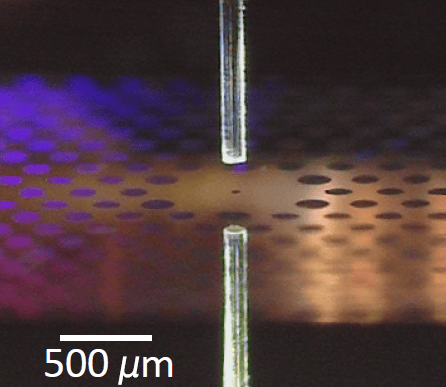
A challenge in the field of optomechanics has been to realize a mechanically compliant mirror that unites high reflectivity with ultracoherent nanomechanics. We have addressed this challenge and developed such a mirror based on a nanopillar metasurface.

Our mirror achieves a reflectivity of 99.82% for a strongly focused beam of 7 micrometer and at the same time hosts an ultracoherent mechanical mode with a quality factor of larger than 10^8, reaching the regime of coherent mechanics at room temperature.

We are confident to achieve even higher reflectivity when using a less absorptive material for the nanopillar patterning.

Curious how it all works? Have a look at our recent preprint: https://arxiv.org/abs/2610.31452

Great work lead by Alexander Jung and Anastasiia Ciers with support from Hannes Pfeifer, Albert Hansson, Johanna Örgård, fiber mirrors from Daniel Stachanow, and theory modeling with Viktor Lilja and Philippe Tassin.
Dynamic state evolution in a nonlinear potential

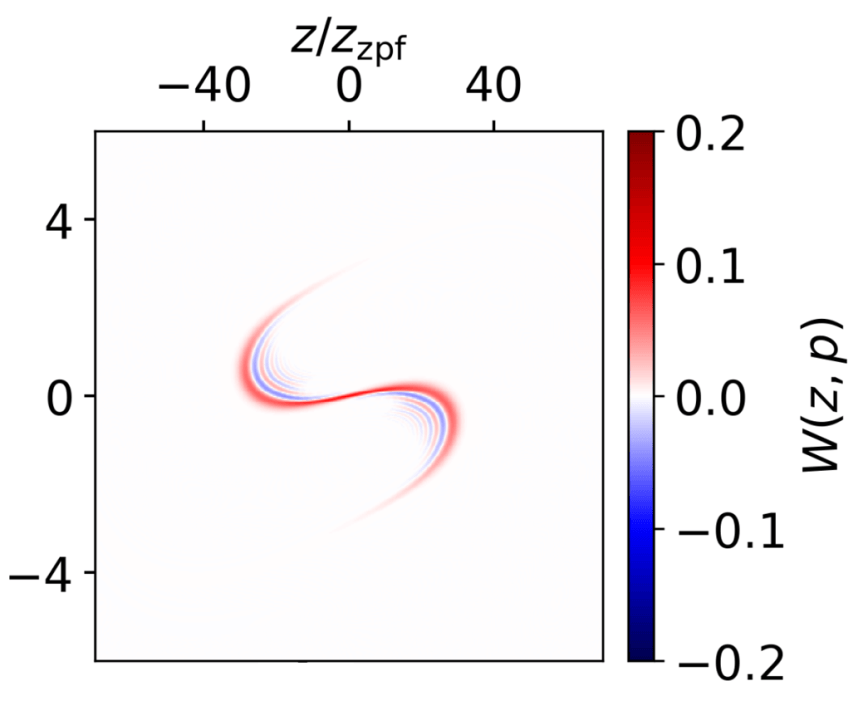
How do we create and verify a non-classical state of a 1 micrometer-sized superconducting particle? In theory, it should work. We use a clever arrangement of coils to generate nonlinear magnetic trap potentials. The superconducting particle is trapped in these and dynamically evolves into a non-classical state.

All details you find in our work published in Quantum Science and Technology.

Fantastic work jointly lead by Jaume Cunill-Subiranas and Fabian Resare with great input from Soucheng Zhao, Sofia Qvarfort, Anja Metelmann, and Carles Navau. Again, a great team work of the EU project SuperMeQ!

Magnetic omniconversion

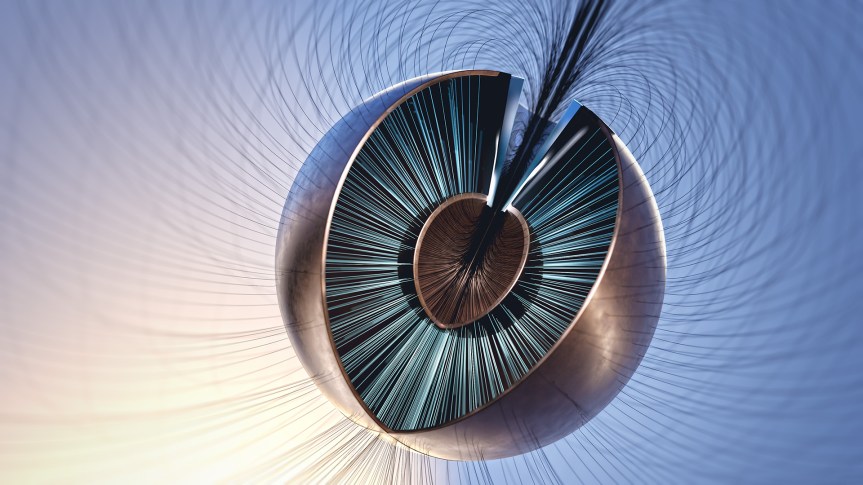
Our joint work on “Magnetic omniconversion: Source-independent molding of magnetostatic fields” has been published in Science Advances!

This work introduces a general method to shape magnetic fields independent of their magnetic sources. Our colleagues from UAB Barcelona developed the theory and we validated it experimentally. A wonderful collaboration within the EU project SuperMeQ! Thanks to Jaume, Fabian, Natanael, Nuria and Carles!

You can read an accessible news article about our work here.

Join Our Lab: Master Thesis Projects 2026/2027 available

Interested in a Master thesis project in our lab? The project ideas for 2026/2027 are out now. We offer thesis projects for 30cr (half a year) and 60cr (full year) on the following topics:

Interested? Just get in contact with us!

Interested in doing a Master thesis in our lab, but with a topic that is more tailored to you? Please contact Witlef.

You can also find these projects on Chalmers thesis portal.

New manuscript: A non-classical motional state of a microparticle

A new preprint from our lab on the arxiv: Macroscopic Quantum Interference of the Center-of-Mass Motion of Levitated Superconducting Microparticles enabled by Magnetic Higher-Order Traps

A long title – but a short message: In this collaborative theory work we outline how one can observe a non-Gaussian motional state of a magnetically levitated superconducting microparticle. We show a clever way of how magnetic fields can be used to generate desired nonlinear potentials, including a double-well or a Duffing potential. The motional state of the superconducting microparticle evolves dynamically in such a potential for a short amount of time. We can show theoretically that non-Gaussian states of the particle’s center-of-mass motion can be generated in such a way and that quantum features of these states can also be verified.

Our work unites desirable features of a future experiment to generate non-classical states of the motion of microscopic objects: (i) long coherence time due to the use of superconducting magnetic levitation, (ii) dynamic state evolution in nonharmonic potentials that realize a nonlinearity on the length scale of hundred times the zero-point motion of the particle, which is about 100 picometer, and (iii) stationary trapping of the same microparticle allowing for repeated experiments to acquire sufficient statistics.

We know now in principle that it may work – the experiment will still be hard to perform.

Thanks for the great collaboration with the groups of Carles Navau, Sofia Qvarfort and Anja Metelmann, and the major drivers of this work: Fabian Resare, Jaume Cunill-Subiranas, and Suocheng Zhao.